
Drag race T135 version
- Thread starter traxxas-modifier
- Start date


docgabby
Super Veteran
05 2008


Torque vs Horsepower, which is more important?
Posted by simonson in Circle Track / Road Racing, Drag Racing, Engine Building, Street Performance, tags: Drag Racing, engine performance, optimum gear ratio, shift RPM
You’ve probably heard various racers and engine builders/tuners talk about torque vs HP. Some say “torque is what moves the car”, other’s say HP is all that matters. Well, you’ll have to put me in the latter camp, because HP is the most important. Torque is how much twisting force you are putting on the driveshaft, typically measured in ft lbs. Horsepower is multiplying this twisting force by RPM (how fast you can keep applying this force).
If we didn’t have gears, than torque would be more important. That’s because in any 1 gear, the torque peak is where the car accelerates the quickest, producing the highest Gs. The torque peak can be important for launching the line, but after that HP is all that matters.
I’ll try to illustrate with some numbers. Gears are torque multipliers. You can get most any torque you want, if you are willing to give up RPM. Say you have 400 ft lbs at 3000 RPM (228 HP) and 350 ft lbs at 6000 RPM (400 HP). If you stay in 3rd gear, you could get .4 Gs acceleration at 3000 (lets say 60 MPH) and .35 Gs of acceleration at 6000 (120 MPH). However, if you shifted 1st gear and put that 400 HP to work at 60 MPH, you could get, say .7 Gs of accel. You may accelerate the quickest in any 1 gear at the torque peak, but you will accelerate quicker in a lower gear at the HP peak.
Racing is all about quickest acceleration to get to the highest speed. Gears let you keep the acceleration high by keeping the engine in its highest HP range. In our Drag Race Analyzer and Circle Track Analyzer programs, they find the optimum shift RPMs or final drive ratios by keeping the engine in its highest HP range. For example, if your engine has peak HP at 6000 RPM, but pulls strong to 7000 RPM, you would probably want to shift at close to 7000 RPM, so when the revs drop back to, say, 5000 RPM, you are still in a high HP range.
Let’s try some real examples, using our easy Drag Race Analyzer v3.2. We’ll try shifting to keep the engine around the torque peak, then letting the computer keeping the RPMs around the HP peak.
Condition Pk Tq Pk HP ET MPH Shift RPMs
Keep Engine at Tq Peak 270 274 13.43 99.46 4700
Computer keeps Engine at HP Peak 270 274 12.66 106.81 6800
Computer keeps Engine at HP Peak 270 268 12.60 107.74 6950
(broader HP peak)
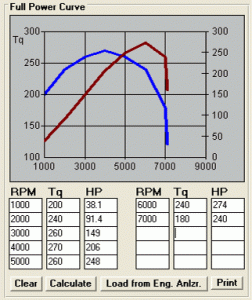
Standard Power Curve
You can see the performance is much better when you keep the engine in the high HP range (12.66 ET) as opposed to the high torque range (13.43 ET). The graph below shows how keeping the engine in a higher HP range in lower gears produces higher acceleration rates.
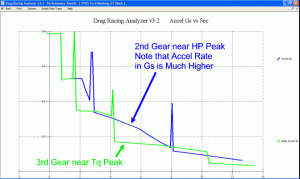
Acceleration in Gs vs MPH. Blue is keeping engine at HP peak, green is keeping engine at torque peak
Click on image to enlarge it.
You will see a third line in the table of results, where I used a power curve with 6 less peak HP, but a broader HP peak. It shows better performance (12.60 ET) than the curve with more peak HP. This makes the point that it is the “area under the HP curve” which is actually most important, or the highest average HP over the RPM range you are using.Power Curve with Lower, but Broader HP Peak
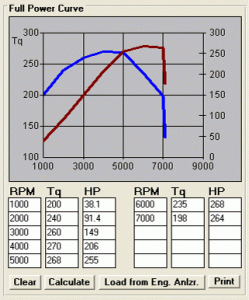
Power Curve with Lower, but Broader HP Peak
To summarize, it is HP through the correct gear ratio which produces best performance. If you are building an engine, you want the highest averageHP through the RPM range you will be using. For a circle track car where you don’t shift, this can be a very broad RPM range. For drag racing with a high stall converter or very narrow ratio transmission, this may be a very narrow RPM range. The Performance Trends vehicle programs like Drag Race Analyzer (std or Pro version), Circle Track Analyzer, or Transmission Gear Calculator will help you optimize your engine and vehicle combo.
Torque vs Horsepower, which is more important?
Posted by simonson in Circle Track / Road Racing, Drag Racing, Engine Building, Street Performance, tags: Drag Racing, engine performance, optimum gear ratio, shift RPM
You’ve probably heard various racers and engine builders/tuners talk about torque vs HP. Some say “torque is what moves the car”, other’s say HP is all that matters. Well, you’ll have to put me in the latter camp, because HP is the most important. Torque is how much twisting force you are putting on the driveshaft, typically measured in ft lbs. Horsepower is multiplying this twisting force by RPM (how fast you can keep applying this force).
If we didn’t have gears, than torque would be more important. That’s because in any 1 gear, the torque peak is where the car accelerates the quickest, producing the highest Gs. The torque peak can be important for launching the line, but after that HP is all that matters.
I’ll try to illustrate with some numbers. Gears are torque multipliers. You can get most any torque you want, if you are willing to give up RPM. Say you have 400 ft lbs at 3000 RPM (228 HP) and 350 ft lbs at 6000 RPM (400 HP). If you stay in 3rd gear, you could get .4 Gs acceleration at 3000 (lets say 60 MPH) and .35 Gs of acceleration at 6000 (120 MPH). However, if you shifted 1st gear and put that 400 HP to work at 60 MPH, you could get, say .7 Gs of accel. You may accelerate the quickest in any 1 gear at the torque peak, but you will accelerate quicker in a lower gear at the HP peak.
Racing is all about quickest acceleration to get to the highest speed. Gears let you keep the acceleration high by keeping the engine in its highest HP range. In our Drag Race Analyzer and Circle Track Analyzer programs, they find the optimum shift RPMs or final drive ratios by keeping the engine in its highest HP range. For example, if your engine has peak HP at 6000 RPM, but pulls strong to 7000 RPM, you would probably want to shift at close to 7000 RPM, so when the revs drop back to, say, 5000 RPM, you are still in a high HP range.
Let’s try some real examples, using our easy Drag Race Analyzer v3.2. We’ll try shifting to keep the engine around the torque peak, then letting the computer keeping the RPMs around the HP peak.
Condition Pk Tq Pk HP ET MPH Shift RPMs
Keep Engine at Tq Peak 270 274 13.43 99.46 4700
Computer keeps Engine at HP Peak 270 274 12.66 106.81 6800
Computer keeps Engine at HP Peak 270 268 12.60 107.74 6950
(broader HP peak)

Standard Power Curve
You can see the performance is much better when you keep the engine in the high HP range (12.66 ET) as opposed to the high torque range (13.43 ET). The graph below shows how keeping the engine in a higher HP range in lower gears produces higher acceleration rates.

Acceleration in Gs vs MPH. Blue is keeping engine at HP peak, green is keeping engine at torque peak
Click on image to enlarge it.
You will see a third line in the table of results, where I used a power curve with 6 less peak HP, but a broader HP peak. It shows better performance (12.60 ET) than the curve with more peak HP. This makes the point that it is the “area under the HP curve” which is actually most important, or the highest average HP over the RPM range you are using.Power Curve with Lower, but Broader HP Peak

Power Curve with Lower, but Broader HP Peak
To summarize, it is HP through the correct gear ratio which produces best performance. If you are building an engine, you want the highest averageHP through the RPM range you will be using. For a circle track car where you don’t shift, this can be a very broad RPM range. For drag racing with a high stall converter or very narrow ratio transmission, this may be a very narrow RPM range. The Performance Trends vehicle programs like Drag Race Analyzer (std or Pro version), Circle Track Analyzer, or Transmission Gear Calculator will help you optimize your engine and vehicle combo.

Kim G Linagatik
New Member
I never had the convenience of a dyno track in our place but i just relied it to the responsiveness of my ride, re: Doc i had choose a under-square because i dont need to really to bang on to my top speed, i just want the responsiveness of my bike like ur cruising normally at 100kph and suddenly accelerate i timed it out from a starting run of 100kph to 140kph 8sec, i don't wanna brag about this but i can top 170kph with just a 400m run, i just wanna go for the responsiveness of my bike i forgot to tell the new specs of my bike now doc its (specs) bore 60mm stroke 64.7 with spacer & stock conrod ( i just used a 3mm conrod pin ) all is stock carburetor is stock but i changed the main jet to 115-120 well the CDI is still stock and im running on 15/37 sprocket ratio well i bought the mio connecting rod it was really shorter by 7mm but another issue occurred i had issued with if the connecting rod will hold up with my bore of 60mm if i stroke it up to 7mm and i use my bike as a daily service to school ( as a deal with my parents to mod my bike ) in my thought if i still can run it daily? i travel around 230km net per day, im just worried that it may break well if this is possible a friend of mine that works on a machine shop offered me jack up my crankshaft instead of by just using a stroker pin ( he said it was much more durable ) also he offerd me his sweet time to balance it real well. well doc and guys do you think a stock mio115 connecting rod will hold up against this kinda torture? would you advice a 7mm stroke over a 60mm bore?


mj viloria
Super Veteran
sir what do you mean by jack up crankshaft?and whats the size of your stroker pin?..im really amazed of how your bike performs..I never had the convenience of a dyno track in our place but i just relied it to the responsiveness of my ride, re: Doc i had choose a under-square because i dont need to really to bang on to my top speed, i just want the responsiveness of my bike like ur cruising normally at 100kph and suddenly accelerate i timed it out from a starting run of 100kph to 140kph 8sec, i don't wanna brag about this but i can top 170kph with just a 400m run, i just wanna go for the responsiveness of my bike i forgot to tell the new specs of my bike now doc its (specs) bore 60mm stroke 64.7 with spacer & stock conrod ( i just used a 3mm conrod pin ) all is stock carburetor is stock but i changed the main jet to 115-120 well the CDI is still stock and im running on 15/37 sprocket ratio well i bought the mio connecting rod it was really shorter by 7mm but another issue occurred i had issued with if the connecting rod will hold up with my bore of 60mm if i stroke it up to 7mm and i use my bike as a daily service to school ( as a deal with my parents to mod my bike ) in my thought if i still can run it daily? i travel around 230km net per day, im just worried that it may break well if this is possible a friend of mine that works on a machine shop offered me jack up my crankshaft instead of by just using a stroker pin ( he said it was much more durable ) also he offerd me his sweet time to balance it real well. well doc and guys do you think a stock mio115 connecting rod will hold up against this kinda torture? would you advice a 7mm stroke over a 60mm bore?
mj viloria
Super Veteran
I LOVE THIS THREAD.. 
Kim G Linagatik
New Member
MJ re; my pin is 3mm, jack up? more like stroke up dunno what is the correct term, But instead of using a stroker pin you bore out a new hole in the crankshaft which you prefer. if you want to jack up or stroke up 3mm you will bore a new hole 3mm above or outer the standard pin is. just like Faito made their jack up 3mm crankshaft, and still just use your stock pin. and the area which the standard pin is removed is filled up( i just dunno how and what material they use)
Quote : if anyone who had been racing or had a idea of the safe limit of stroke to bore ratio please let me know, or either other alternative connecting rod that would be
much more durable for a 60mm bore and either would be 5mm-7mm stroke. im really having a hard time to just thingking if the stock connecting rod of a MIO 115
stock connecting rod will hold against this stress.
docgabby
Super Veteran
Connecting Rod Length Influence on Power
by William B. Clemmens
A spark ignition (SI) engine and a steam engine are very similar in principle. Both rely on pressure above the piston to produce rotary power. Pressure above the piston times the area of the bore acts to create a force that acts through the connecting rod to rotate the crankshaft. If the crankshaft is looked at as a simple lever with which to gain mechanical advantage, the greatest advantage would occur when the force was applied at right angles to the crankshaft. If this analogy is carried to the connecting rod crankshaft interface, it would suggest that the most efficient mechanical use of the cylinder pressure would occur when the crank and the connecting rod are at right angles. Changing the connecting rod length relative to the stroke changes the time in crank angle degrees necessary to reach the right angle condition.
A short connecting rod achieves this right angle condition sooner than a long rod. Therefore from a "time" perspective, a short rod would always be the choice for maximum torque. The shorter rod achieves the right angle position sooner and it does so with the piston slightly farther up in the bore. This means that the cyl pressure (or force on the piston) in the cylinder is slightly higher in the short rod engine compared to the long rod engine (relative to time).
Table 1
ROD LENGTH RELATIONSHIPS*
(with Crank @ 90 deg ATDC)
Piston Position Crankpin/Rod Angle
StrokeRod LengthRod Anglefrom TDCATDC
3.5 5.70 17.88 2.025 72.12
3.5 5.85 17.40 2.018 72.59
3.5 6.00 16.96 2.011 73.04
3.5 6.20 16.39 2.002 73.60
Table 2
ROD LENGTH RELATIONSHIPS with CRANKPIN/ROD centerline @ 90o @ 7500 rpm
Stroke Rod Length Rod Angle Piston Distance Crank Angle Piston Accel
3.5 5.70 17.07 1.487 72.93 2728.35
3.5 5.85 16.65 1.494 73.35 2504.72
3.5 6.00 16.26 1.500 73.74 2324.26
3.5 6.20 15.76 1.508 74.24 2097.27
*data from Jere Stahl
Another concern in selecting the rod length is the effects of mechanical stress imposed by increasing engine speed. Typically, the concept of mean piston speed is used to express the level of mechanical stress. However, the word "mean" refers to the average speed of the piston in going from the top of the bore to the bottom of the bore and back to the top of the bore. This distance is a linear distance and is a function of the engine stroke and engine speed, not rod length. Therefore, the mean piston speed would be the same for each rod length listed in Table 1.
Empirical experience; however, indicates that the mechanical stress is less with the longer rod length. There are two reasons for these results. Probably the primary reason for these results is that the profile of the instantaneous velocity of the piston changes with rod length. The longer rod allows the piston to come to a stop at the top of the bore and accelerate away much more slowly than a short rod engine. This slower motion translates into a lower instantaneous velocity and hence lower stresses on the piston. Another strong effect on mechanical stress levels is the angle of the connecting rod with the bore centerline during the engine cycle. The smaller the centerline angle, the less the side loading on the cylinder wall. The longer rod will have less centerline angle for the same crank angle than the shorter rod and therefore has lower side loadings.
Classical textbooks by Obert ( ) and C.F. Taylor ( ) provide little guidance on the rod length selection for passenger or commercial vehicles other than to list the ratios of rod length to crank radiuses that have been used by various engine designs. Race engine builders using production blocks have done quite a bit of experimentation and have found many drivers are capable of telling the difference and making clear choices along with similar results from motorcycle flat track racers/builders.
Because of recent developments in computer modeling of the engine cycle by R.D. Rabbitt ( ), another factor may be critical in selecting a given connecting rod length. This new factor is the cylinder head flow capability versus connecting rod length over stroke ratio (l/r) versus engine speed. To understand this relationship, let us first review previous techniques used to model air flow during the engine cycle which as Rabbitt points out is founded on principles initiated in 1862 and refined in 1920. These theories are documented in Taylor's textbook ( ). To calculate air flow throughout the cycle these models use such parameters as mean or average inlet mach number for the port velocity and an average inlet valve discharge coefficient which compensate for valve lift and duration. In these models a control volume is used to define the boundaries of the combustion chamber. The air flow determined by the previous parameters crosses this boundary to provide air (and fuel) for the combustion process within the control volume.
However, this control volume has historically been drawn in a manner that defines the boundaries of the combustion chamber in the area of the inlet and exhaust valves as if the valves were removed from the cylinder head (ie. a straight line across the port). With the valves effectively removed, the previously mentioned average port flow and valve discharge coefficient (ie. valve restriction) are multiplied within current computer models to quantify the air flow (and fuel) delivered for each intake stroke. But, as Rabbitt points out, this approach totally ignores the effect of the air flow direction and the real effect of valve lift on the total air flow that can be ingested on each intake stroke.
Rabbitt reaches two important conclusions from his study. One, because of the direction of the air flow (angle and swirl) entering the combustion chamber, three dimentional vorticies are set up during the intake stroke. Two, that above a certain piston speed, density of the mixture at the piston face is a function of valve geometry and valve speed. Rabbitt further discusses the effect of the first conclusion as it relates to the mass of air that is allowed to flow through the port and by the valve. Vorticies can exhibit different characteristics and in general conform to two general types--large scale bulk vorticies that could be described as smooth in nature and small scale eddies that are highly turbulant.
If one can consider that the vacuum produced by the piston on its downward travel to be the energy that causes the air to flow through the port when energy losses throughout the intake tract (including losses at the valve) are at a minimum, the flow delivered to the chamber will be maximized. If the area between the piston face and the valve is also included in the consideration of flow losses, the effect of the type of vorticies created can be more easily understood. Large scale bulk vorticies comsume less energy than highly turbulent eddy vorticies. Thus, more of the initial energy from the piston's downward movement is available at the port-valve-combustion chamber interface with which to draw the intake charge into the chamber. Small scale eddies eat up energy which reduces the amount of the initial energy that reaches the port-valve-combustion chamber interface which in turn, reduces the port flow.
Rabbitt's second conclusion follows that at some higher piston speed, the vorticies within the combustion chamber (which are assumed to be large scale bulk type at low speeds) transition from the bulk type to the small scale eddy type. At this point the flow into the combustion chamber ceases to increase in proportion to increases in engine speed. It is theorized that this flow transition point can be observed on the engine power curve as the point at which the power curve begins to fall off with increasing engine speed.
As indicated earlier, piston speed is normally viewed as mean or average piston speed. Thus for a given engine, the mean piston speed increases as the rotational engine speed increases. However, in Rabbitt's model the piston speed of concern is the instantaneous piston speed during the intake stroke near TDC. For any given engine, changing the rod length to stroke (l/r) ratio changes the instantaneous piston speed near TDC. For the purposes of flow visualization, the type of vortex formed should not care whether a given instantaneous piston speed had been achieved by a given rotational speed or changing the (l/r) ratio and operating at a new rotational speed. As long as the instantaneous piston velocity is the same, the type of vorticies formed should be the same and the amount of air inducted into the cylinder should be the same.
If other factors influenced by rotational speed such as the time distance between slug of intake air flow and valve opening rates relative to the acceleration of the air slugs were ignored, one should be able to predict the location (RPM) of the peak power as a result of a change in the (l/r) ratio. Note, that even though power is a funtion of air flow and air flow should be roughly constant for the same instantaneous piston speed (neglecting the afore mentioned factors), the power may not be the same because of the lever arm effect between the crank radius and the connecting rod. (As we noted earlier, the shorter rod should have the advantage in the lever arm effect.)
In reality, the analysis must be viewed by stroke (ie intake, compression, exhaust, power) the selection of exhaust valve opening time combined with the exhaust system backpressure and degree of turbulance the exhaust port experiences. If the exhaust port has good turbulance control then you may run a shorter rod which allows you to use more exhaust lobe which reduces pumping losses on the exhaust stroke.
docgabby
Super Veteran
Rod Length Relationships
You are invited to participate in this attempt to understand a part of internal combustion engines. I invite any/all criticisms, suggestions, thoughts, analogies, etc.-- written preferred, phone calls accepted from those too feeble or who have arthritis. Contributors are invited to request special computer printouts for specific combinations of interest to them.
In general, most observations relate to engines used for some type of competition event and will in general produce peak power higher than 6000 RPM with good compression ring seal as defined by no more than 3/16 CFM blowby per cylinder.
Short Rod is slower at BDC range and faster at TDC range.
Long Rod is faster at BDC range and slower at TDC range.
I. LONG ROD
A. Intake Stroke -- will draw harder on cyl head from 90-o ATDC to BDC.
B. Compression Stroke -- Piston travels from BDC to 90-o BTDC faster than short rod. Goes slower from 90-o BTDC to TDC--may change ign timing requirement versus short rod as piston spends more time at top. However; if flame travel were too fast, detonation could occur. Is it possible the long rod could have more cyl pressure at ie. 30-o ATDC but less crankpin force at 70-o ATDC. Does a long rod produce more efficient combustion at high RPM--measure CO, CO2? Find out!!
C. Power Stroke -- Piston is further down in bore for any given rod/crank pin angle and thus, at any crank angle from 20 to 75 ATDC less force is exerted on the crank pin than a shorter rod. However, the piston will be higher in the bore for any given crank angle from 90-o BTDC to 90-o ATDC and thus cylinder pressure could be higher. Long rod will spend less time from 90-o ATDC to BDC--allows less time for exhaust to escape on power stroke and will force more exhaust out from BDC to 90-o BTDC. Could have more pumping loss! Could be if exhaust port is poor, a long rod will help peak power.
D. Exhaust Stroke -- see above.
II. Short Rod
A. Intake Stroke -- Short rod spends less time near TDC and will suck harder on the cyl head from 10-o ATDC to 90-o ATDC the early part of the stroke, but will not suck as hard from 90-o to BDC as a long rod. Will require a better cyl head than long rod to produce same peak HP. Short rod may work better for a IR or Tuned runner system that would probably have more inertia cyl filling than a short runner system as piston passes BDC. Will require stronger wrist pins, piston pin bosses, and connecting rods than a long rod.
B. Compression Stroke -- Piston moves slower from BDC to 90-o BTDC; faster from 90-o BTDC to TDC than long rod. Thus, with same ign timing short rod will create less cyl compression for any given crank angle from 90-o BTDC to 90-o ATDC except at TDC. As piston comes down, it will have moved further; thus, from a "time" standpoint, the short rod may be less prone to detonation and may permit higher comp ratios. Short rod spends more time at the bottom which may reduce intake charge being pumped back out intake tract as valve closes--ie. may permit longer intake lobe and/or later intake closing than a long rod.
C. Power Stroke -- Short rod exerts more force to the crank pin at any crank angle that counts ie.--20-o ATDC to 70-o ATDC. Also side loads cyl walls more than long rod. Will probably be more critical of piston design and cyl wall rigidity.
D. Exhaust Stroke -- Stroke starts anywhere from 80-o to 110-o BBDC in race engines due to exhaust valve opening. Permits earlier exhaust opening due to cyl pressure/force being delivered to crank pin sooner with short rod. Requires a better exhaust port as it will not pump like a long rod. Short rod has less pumping loss ABDC up to 90-o BTDC and has more pumping loss from 90-o BTDC as it approaches TDC, and may cause more reversion.
III. NOTES
A. Rod Length Changes -- Appears a length change of 2-1/2% is necessary to perceive a change was made. For R & D purposes it appears a 5% change should be made. Perhaps any change should be 2 to 3%--ie. Ignition timing, header tube area, pipe length, cam shaft valve event area, cyl head flow change, etc.
B. Short Rod in Power Stroke -- Piston is higher in the bore when Rod-Crank angle is at 90-o even though at any given crank angle the piston is further down. Thus, at any given "time" on the power stroke between a rod to crank pin angle of 10o and ie. 90-o, the short rod will generate a greater force on the crank pin which will be in the 70-o to 75-o ATDC range for most engines we are concerned with.
C. Stroke -- Trend of OEM engine mfgs to go to longer stroke and/or less over square (bore numerically higher than stroke) may be a function of L/R. Being that at slower engine speeds the effect of a short rod on Intake causes few problems. Compression/Power Stroke should produce different emissions than a long rod. Short rod Exhaust Stroke may create more reversion--EGR on a street engine.
D. More exhaust lobe or a earlier exhaust opening may defeat a longer rod. I am saying that a shorter rod allows a earlier exhaust opening. A better exhaust port allows a earlier exhaust opening.
E. Definition of poor exhaust port. Becomes turbulent at lower velocity than a better port. Flow curve will flatten out at a lower lift than a good port. A good exhaust port will tolerate more exhaust lobe and the engine will like it. Presuming the engine has adequate throttle area (so as not to cause more than 1" Hg depression below inlet throttle at peak power); then the better the exhaust port is, the greater the differential between optimum intake lobe duration and exhaust lobe duration will be--ie. exh 10-o or more longer than intake Carbon buildup will be minimal if cyl is dry.
IV. DEFINITIONS
Short Rod -- Min Rod/Stroke Ratio -- 1.60 Max Rod/Stroke Ratio -- 1.80
Long Rod -- Min Rod/Stroke Ratio -- 1.81 Max Rod/Stroke Ratio -- 2.00
Any ratio's exceeding these boundaries are at this moment labeled "design screw-ups" and not worth considering until valid data supports it.
Contributors to Date: Bill Clemmons, Jere Stahl
docgabby
Super Veteran
Bored & Stroked
Increasing the stroke lenght increases Cubic Inch Displacement (CID), which increase Torque (TQ measure in pounds per foot {ft-lbs}), but also increases friction, which consumes Horsepower (HP).
Brake Horsepower (BHP)is measured at the flywheel on an engine dyno. RWHP is measured at the rear wheels on a chassis dyno.
I recommend using low drag rings and pistons to help offset this fictional power loss and lighter weight pistons and rods.
Additionally the increased stroke lowers the peek TQ Revolutions Per Minute (RPM), which is a good thing for street machines.
More torque at lower RPM means more rapid acceleration.
The follow examples are extremes to illustrate the point.
Bore 5.00" X Stroke 2.44" = 383 421TQ/4000rpm 380HP/5200rpm
Bore 4.03" X Stroke 3.75" = 383 417TQ/3700rpm 368HP/5000rpm
Bore 3.00" X Stroke 6.78" = 383 387TQ/3500rpm 313HP/4700rpm
Increasing the engine's CID by stroking increases the torque, but as you can see CAN also reduce horsepower as you can see.
This is true whether the increase comes from a longer stroker or a larger bore diameter.
However increasing the bore diameter produces more torque less horsepower lost to friction than stroking. The horsepower is lost to friction. It is more desirable to increase bore diameter to make power, but once the bore is bigger, more stroke will make more power again. However bigger engine do make more power, see bottom of page.
5.00" X 6.78" = 1065 1150TQ/4000rpm 378HP/2000rpm 2HP/4200
When stroking a mild performance or stock engine, the top end HP can be a negative number, but the lower RPM numbers will be a gain.
Increasing valve lift can help to offset this BHP loss, and helps supply more air/fuel to fill the greater cylinder displacement.
For example a stock 350 to 383 conversion. Two sets of figures show the low speed power and the peek numbers. Bore X Stroke = CID
4.03" X 3.48" = 355 355TQ/2000rpm 175HP/2500rpm 395TQ/4000rpm 365HP/5500rpm
4.03" X 3.75" = 383 389TQ/2000rpm 191HP/2500rpm 417TQ/3600rpm 368HP/5000rpm
+34TQ/2000rpm +16HP/2500rpm Peek Power +22TQ +3HP
Notice the torque and horsepower went up in the lower RPM range and the gain in TQ remained at the peek output RPM. In this application we did not loose BHP, but the gain was minimal. Increasing the stoke to theoretical 4.1" (too long to fit in block) will loose BHP as you can see below.
4.03" X 4.10" = 418 432TQ/2000rpm 210HP/2500rpm 447TQ/3300rpm 364HP/4900rpm
+77TQ/2000rpm +35HP/2500rpm Peek Power +52TQ -1HHP
The longer stroke also reduced the RPM where the peek power numbers occured.
This is ideal for street performance. Increasing camshaft lift will move the power band back up.
Here is the same 418 with 1.6:1 rockers to increase the lift.
4.03" X 4.1" = 418 432TQ/2000rpm 210HP/2500rpm 448TQ/3500rpm 369HP/5000rpm
+77TQ/2000rpm +35HP/2500rpm Peek Power +53TQ +4HP
Here we see the bootom end power remain the same, but the extra lift help pick up the top end.
To further illustrate the results of boring and stroking, let's look at some numbers generated by a computer dynamometer.
Entry level computer dynos like the one I use can not duplicate the "real world", but they can come close and are very useful for evaluating various combinations. More expensive P/C dynos can better duplicate the "real world", but require exhaustive data entry.
Let's start with a Small Block Chevy 350, first boring it over size, then make it a 383.
Then use a 400 block and stroke it some more, then use an aftermarket block.
Bore X Stroke = CID
4.00" X 3.48" = 350 390TQ/4000rpm 364HP/5500rpm + 0TQ + 0HP
4.03" X 3.48" = 355 395TQ/4500rpm 365HP/6000rpm + 5TQ + 1HP
4.06" X 3.48" = 360 400TQ/4500rpm 366HP/5500rpm + 10TQ +2HP
4.03" X 3.75" = 383 417TQ/3800rpm 368HP/5000rpm +27TQ + 4HP
4.03" X 4.00" = 408 439TQ/3500rpm 367HP/4800rpm +47TQ + 3HP
4.15" X 3.48" = 377 414TQ/4000rpm 370HP/5000rpm +24TQ +6HP
4.15" X 3.75" = 407 438TQ/3600rpm 371HP/4800rpm +48TQ +7HP
4.15" X 4.00" = 434 460TQ/3400rpm 366HP/4500rpm +80TQ +2HP
4.25" X 3.48" = 426 429TQ/3800rpm 373HP/5000rpm +39TQ +9HP4.25" X 3.75" = 426 455TQ/3600rpm 370HP/5000rpm +65TQ +6HP4.25" X 4.12" = 468 495TQ/2500rpm 367HP/4500rpm +105TQ +3HP4.25" X 4.25" = 482 510TQ/3500rpm 364HP/4500rpm +120TQ +0HP
As you can see stroking makes TQ, but the biggest HP gain came from increasing the bore and leaving the stroke at 3.48" To make the BIG BHP power gains, we add more cam duration, compression and better flowing heads. Typically a 383 will make between 400 to 520BHP in a street performance application. Keep in mind that horsepower is related to RPM, so the high you rev the engine the more BHP you can make. Torque is increased with more cubic inches and better volumetric (air in exhaust out) and thermal (burning of the fuel) efficiency.
Why Increase The Stroke?
It makes the engine bigger. BIGGER ENGINES MAKE MORE POWER
The increased engine size will accelerated harder with the extra torque and stroking is the most affordable way to increase engine size. As you can see both increasing the bore diameter and increasing the stroke increases the torque. However increasing the bore diameter is more desirable to make both more torque and more horsepower. As you can see from the 426 verses 482 combos the smaller motor looks like the better choice for making horsepower, but keep in mind that you can exchange torque for horsepower. Or in other words bigger valves, ports, carb, cam and headers will give the following results.
4.25" X 3.48" = 426 429TQ/3800rpm 373HP/5000rpm +39TQ +9HP4.25" X 4.25" = 482 510TQ/3500rpm 364HP/4500rpm +120TQ +0HP
Which motor would you choose?
The end result being more torque with no lost in horsepower.
Why Increase The Bore?
Increasing the bore sizes results in more net power, but .060" isn't enough to make an impressive difference, and is the limited over bore for most blocks. The only options are stepping up to a big block if using a small block, or in the case of SB Chevys using a 400 block, or buying an aftermarket block such as a Dart Iron Eagle.
These blocks close close to $2000
As you can see from the exaggerated extremes at the top of this article, the big bore short stroke engine made the biggest gains, while the small bore long stroke gave up all the horsepower.
The realistic .030 over with a 3.75" stroke made almost as much torque as the large bore motor, but wasn't impressive in producing HP.
To compensate increasing airflow at the high RPM and trading torque for horsepower is effective. For example changing the intake manifold from a duel plenum to a single plenum will produce these results.
Duel Plenum 4.03" X 3.75" = 383 406TQ/4000rpm 374HP/5500rpm
Single Plenum 4.03" X 3.75" = 383 416TQ/4000rpm 396HP/5500rpm
+10TQ +22HP
While these numbers look better, we need to look at the lower RPM number to decide if a single plenum is what we really want.
Single Plenum 4.03" X 3.75" = 383 348TQ/2500rpm 166HP/2500rpm
Duel Plenum 4.03" X 3.75" = 383 372TQ/2500rpm 177HP/2500rpm +24TQ +11HP
At this speed the duel plane/plenum manifold will be accalerating faster. What this reveals is power can be produced with more cubic inches or from more RPM, YOU CHOOSE!
In the real would some combination work better than others.
The Stroker Engine Company will help you find the best combination for you application and budget.
My motto is bigger engines make more power. While the computer may predict only a small increase in BHP, in the real world more BHP is made at lower RPM.
Here is a 355cid verse a 427cid as tested by Popular Hot Rodding Magazine using the same heads and camshaft.
RPM 355 TQ - BHP 427 TQ - BHP
2600 346 - 171 507 - 251 increase 161TQ 80BHP
3600 422 - 290 549 - 376 increase 127TQ 87BHP
4600 456 - 399 556 - 487 increase 100TQ 88BHP5600 444 - 474 475 - 507 increase 31TQ 34BHP
6000 425 - 486 418 - 478 loss 7TQ 8BHP
Peek TQ 5000 458 4000 570
Peek BHP 6000 486 5400 512
docgabby
Super Veteran
Rod to Stroke Ratios


To get the rod to stroke ratio, simply divide the short stroker number in to the longer rod number. 5.700 rod divide by a 3.48 stroke equals 1.6379:1 (1.64:1)


Basically we want a Rod to Stroke ratio of 1.55:1 or higher to reduce side loading force on the thrust side of the piston to minimize friction. This becomes more critical above 5500rpm. The factory Chevy 400 had really short 5.565 rods and a 3.750 stroke having a 1.48:1 ratio. This motor works fine to 5500rpm, then you can experience a hard or harsh feeling for the motor, not vibration but kind of like it. By putting 5.700 rods in this motor it well happily buzz over 6000RPM with a 1.52:1 ratio.
Next we want a piston with better than 1.250 compression height, the distance from wrist pin centerline to piston top.
The greater the compression height meaning the longer the piston skirt, which in addition to transferring heat, keeps the piston vertical in the cylinders.
When we increase stroke length the piston is push up above the top of the block, so we move the wrist pin further up towards the rings, pulling the piston top back below the top of the block. Additionally we often install longer rods with the longer stroke to keep a good rod to stroke ratio, which also requires moving the pin up piston.

The limit is the oil ring. We can go as height as the top of the oil ring groove, and even push the oil ring up toward the top of the piston by reducing the thickness of the top and second ring lands.
But here to there are limits, required to maintain enough strength in the ring lands to support the rings. Placing the wrist pin in the oil ring grooves requires fitting a steel rail under the oil ring in a wider groove than the ring. The rail helps support the oil ring and is fitted after the wrist pin is installed through the rod and the clips are installed.
This set up is more than adequate to allow the oil ring to function as it would in a conventional groove.
I do my best to provide a combination with the best compromise of rod length piston compression height and stroke, all fitting in the block without collision, all focused on long street use life.
When building a performance motor we are constantly challenged with compromises.
In this case as we move the wrist pin up the piston, the piston becomes shorter.
The shorter piston then tends to rock in the cylinder as it moves up and down, because there is less skirt surface area to support the piston.
Further complicating matters is that we typically use a forged piston have 0.004" or more clearance allowing even more rocking, than a cast piston with 0.002" clearance would experience.
This rocking makes it more difficult to keep the rings straight and sealed.
Even though the rocking is not very much it does reduce the effectiveness of the ring seal leading to some increase in oil consumption.
The compromise here is to choose either the longest stroke for more power, or a shorter stroke increase to burn less oil.
This issue is most often discuss in relationship to Ford 331cid verses 347cid strokers.
Will a 347 burn more oil? Very possibly. Using a Keith Black hypereutectic piston with 0.00175 clearance will help, but most people want forged pistons.
Will a 331 last longer than a 347? Maybe, but any difference will not be great.
What are we talking about here, engine life?
A motor may start smoking when the rings wear and loose a percentage of their seal. Worn bearing adds to the oil thrown on to the cylinder wall making a tired ring work even harder. However valve guides tend to wear out sooner than the rings, so likely you will have the heads off for a rebuild before the rings let you down.
See what Hastings Manufacturing has to say on the subject.
 So is a 347 or 331 better. A 347 being 16cid bigger, a strong running motor making say 1.3 foot pounds of torque per cubic inches the 347 will make another twenty foot pounds than the 331. Peek horsepower will be much the same, but the 347 will make it at a slightly lower RPM, say 200rpm.
So if you want minimal oil consumption and guessing now, another 10,000 miles before needing to replace the rings and possible the pistons, give up a little power an build a 331.
I can build a 331 to make 440bhp, which is quite a bit for such a small motor.
I don't hear people talking about other motor relative to this issue, but it does apply equally.
Personally I think this question applied to the 347 is a little over blown.
The 5.400 rod to 3.400 stroke ratio is 1.59:1 very good, but the piston compression height(CH) is 1.09", not so good.
The 331 ratio is 1.66, plenty and the CH 1.175, better but less than ideal.
 Probe offers a very useful improved compromise for the 347.
By using the 331 piston with it's 1.175 CH and making a shorter 5.315 rod, the ratio is 1.56, still quite good, but now the piston in the 347 is as at lest good as the 331. The real benefit is the longer piston, not keeping the pin out of the oil ring groove. To do better means giving up stroking.
Small block Chevys are limited by camshaft clearance. A 4.00 stroke crank can be installed, but the rod ratio will limit RPM. Because this results in a lower speed motor, it makes sense to capitalize on this as much as possible. Using a short rod may limit peek RPM, but it increases low speed torque with greater leverage from the piston through the rod to the crankshaft. This is because the rod "lays over" at a greater angle as it descends down the cylinder.
Using a short rod allows us to use a longer piston, helping the piston to stay straight and the rings to remain sealed.
This situation reoccurs in all engines, including monster aftermarket blocks as we install the limits of crankshaft stroke.
Big engines at high RPM are race motors and are not expect to run "forever".
However these mountain motors make for extremely powerful street motors where tall gears can take advantage of the huge torque output, and cruise at high speed, but low RPM.
Traction will be your greatest challenge.


One obvious question might be why not just keep the skirt length long even though the pin has been raised?
The problem is as the pin moves away from the bottom of the piston shirt the leverage is increased. As the piston rocks on the pin centerline the further away the bottom of the shirt is the greater the pressure is on the skirt against the cylinder wall. This increased pressure can bend the shirt tang(very bottom of the skirt) increasing clearance leading to increased rock and noise. The skirt eventually may just break.
We tend to leave it to the piston manufacturer to choose the best skirt length for any particular application. To solve this problem, especially when we want to add as much stroke as possible we must turn to taller aftermarket blocks with increased deck heights, raised camshafts and widen oil pan rails. Dart and World are the most common sources, but there are also Brodix, Donovan, Aries, Bowtie, Eliminator and Ford Racing
Taller blocks allow longer strokes, rods and pistons. However we soon find we want to use all this extra length to stuff in really long stroke crankshafts and we find ourselves back with reduced rod/stroke ratios and short pistons.
Even the extremely tall World Merlin Superblock for big block Chevys with it's 11.625 deck height has a crappy 1.47:1 with 7.80 rods and a 5.30 crank and 1.175 CH, but then with 705cid you don't need to rev it to the moon.
One other consideration is the stroke to bore ratio. A bore of 4.00 and a stroke of 4.00 is said to be "square". A bore of 4.00 and a stroke of 5.00 would be "under square, 4.00 X 3.00 "over square".
Over square tends to rev up quicker and make more horsepower than an under square motor. Having a longer stroke making the motor under square means the pistons and rings have to travel further. This means more fiction and acceleration to maximum piston travel speed. This acceleration like the increased friction takes power away from going out the flywheel. The engine revs up more slowly, but as it produces more torque, until about 4000rpm where the friction and inertia resistance really begins to rob power, the motor makes the weight of the vehicle seem less -power to weight ratio- and so till around 4000rpm the longer stroke, slower to revving up motor will likely accelerate the vehicle faster, than a similar size cubic inch displacement motor have a bigger bore, shorter stroke combination. However this latter motor will eventually catch up an pass as top speeds are achieved.
It is more desirable to have a big cylinder short stroke motor, but using production engines means we can't increase cylinder size in any meaningful way, so we stuff in more stroke.
As I mentioned, increasing stroke lengths can reduce piston and ring life due to the less than ideal rod to stroke ratio and can cause some oil consumption.
These issue are not desirable, but it is the compromise we must make to have the extra power this combination produces.
To minimize problems I focus on the details, such as paying close attention to proper cylinder honing and cleaning.
I also recommend Total Seal Gapless Top Rings. Click Here
While these gapless rings have proven to make more horsepower, torque and vacuum, it is their longer service life that convinces me they are worth the additional expense.
Engines with increased stroke lengths increase piston speed.
All engine have the same time to get the piston from the top of the cylinder to the bottom, half a revolution.
If the piston travels 3" it will not have to accelerate to as high a speed at half stroker, then decelerate to dead stop at the bottom of the cylinder as a piston traveling 4".
These speeds are measured in feet per second.
As RPM is increased, so is this feet per second number.
Therefore a 4" stroke truck motor never revving over 4500rpm would not see as high a feet per second number as a 3" stroke motor revving 6500, or in these two cases 4" @ 4500rpm is 50' per second and 3" 2 6500rpm is 54.2' per second. See Caculator
What this means is, the higher you rev and engine the sooner you will need new rings.
So if you want a motor that last 100,000 miles don't build a motor that makes a ton of power and revs to the moon.
But if you do want a motor that man lesser men weak and causes women to faint, don't expect it to last as long as a stock production motor.
My goal in building high performance street engines is to make the most power in a given RPM range, have the most vacuum for the brakes, and have the longest possible longevity.

Below are some numbers relating to this subject for most of the stroker engines we might build using a factory block. CID is based on a 0.030 over bore.
Very often the distance between the crankshaft and camshaft centerlines restrict stroke increases as the rods begin to interfere with camshaft rotation.
Pushing the stroke limits may result is less than ideal rod to stroke ratios and require using short pistons resulting in a higher level of oil consumption, but the engine will make more torque.
In these application I prefer to choose a compromise, which favors a longer pistons to help with oil control as the engines application is more likely to be used in vehicle revving under 5500rpm.
To get the rod to stroke ratio, simply divide the short stroker number in to the longer rod number. 5.700 rod divide by a 3.48 stroke equals 1.6379:1 (1.64:1)
Basically we want a Rod to Stroke ratio of 1.55:1 or higher to reduce side loading force on the thrust side of the piston to minimize friction. This becomes more critical above 5500rpm. The factory Chevy 400 had really short 5.565 rods and a 3.750 stroke having a 1.48:1 ratio. This motor works fine to 5500rpm, then you can experience a hard or harsh feeling for the motor, not vibration but kind of like it. By putting 5.700 rods in this motor it well happily buzz over 6000RPM with a 1.52:1 ratio.
Next we want a piston with better than 1.250 compression height, the distance from wrist pin centerline to piston top.
The greater the compression height meaning the longer the piston skirt, which in addition to transferring heat, keeps the piston vertical in the cylinders.
When we increase stroke length the piston is push up above the top of the block, so we move the wrist pin further up towards the rings, pulling the piston top back below the top of the block. Additionally we often install longer rods with the longer stroke to keep a good rod to stroke ratio, which also requires moving the pin up piston.
The limit is the oil ring. We can go as height as the top of the oil ring groove, and even push the oil ring up toward the top of the piston by reducing the thickness of the top and second ring lands.
But here to there are limits, required to maintain enough strength in the ring lands to support the rings. Placing the wrist pin in the oil ring grooves requires fitting a steel rail under the oil ring in a wider groove than the ring. The rail helps support the oil ring and is fitted after the wrist pin is installed through the rod and the clips are installed.
This set up is more than adequate to allow the oil ring to function as it would in a conventional groove.
I do my best to provide a combination with the best compromise of rod length piston compression height and stroke, all fitting in the block without collision, all focused on long street use life.
When building a performance motor we are constantly challenged with compromises.
In this case as we move the wrist pin up the piston, the piston becomes shorter.
The shorter piston then tends to rock in the cylinder as it moves up and down, because there is less skirt surface area to support the piston.
Further complicating matters is that we typically use a forged piston have 0.004" or more clearance allowing even more rocking, than a cast piston with 0.002" clearance would experience.
This rocking makes it more difficult to keep the rings straight and sealed.
Even though the rocking is not very much it does reduce the effectiveness of the ring seal leading to some increase in oil consumption.
The compromise here is to choose either the longest stroke for more power, or a shorter stroke increase to burn less oil.
This issue is most often discuss in relationship to Ford 331cid verses 347cid strokers.
Will a 347 burn more oil? Very possibly. Using a Keith Black hypereutectic piston with 0.00175 clearance will help, but most people want forged pistons.
Will a 331 last longer than a 347? Maybe, but any difference will not be great.
What are we talking about here, engine life?
A motor may start smoking when the rings wear and loose a percentage of their seal. Worn bearing adds to the oil thrown on to the cylinder wall making a tired ring work even harder. However valve guides tend to wear out sooner than the rings, so likely you will have the heads off for a rebuild before the rings let you down.
See what
Hastings Manufacturing has to say on the subject.
So if you want minimal oil consumption and guessing now, another 10,000 miles before needing to replace the rings and possible the pistons, give up a little power an build a 331.
I can build a 331 to make 440bhp, which is quite a bit for such a small motor.
I don't hear people talking about other motor relative to this issue, but it does apply equally.
Personally I think this question applied to the 347 is a little over blown.
The 5.400 rod to 3.400 stroke ratio is 1.59:1 very good, but the piston compression height(CH) is 1.09", not so good.
The 331 ratio is 1.66, plenty and the CH 1.175, better but less than ideal.
By using the 331 piston with it's 1.175 CH and making a shorter 5.315 rod, the ratio is 1.56, still quite good, but now the piston in the 347 is as at lest good as the 331. The real benefit is the longer piston, not keeping the pin out of the oil ring groove. To do better means giving up stroking.
Small block Chevys are limited by camshaft clearance. A 4.00 stroke crank can be installed, but the rod ratio will limit RPM. Because this results in a lower speed motor, it makes sense to capitalize on this as much as possible. Using a short rod may limit peek RPM, but it increases low speed torque with greater leverage from the piston through the rod to the crankshaft. This is because the rod "lays over" at a greater angle as it descends down the cylinder.
Using a short rod allows us to use a longer piston, helping the piston to stay straight and the rings to remain sealed.
This situation reoccurs in all engines, including monster aftermarket blocks as we install the limits of crankshaft stroke.
Big engines at high RPM are race motors and are not expect to run "forever".
However these mountain motors make for extremely powerful street motors where tall gears can take advantage of the huge torque output, and cruise at high speed, but low RPM.
Traction will be your greatest challenge.
One obvious question might be why not just keep the skirt length long even though the pin has been raised?
The problem is as the pin moves away from the bottom of the piston shirt the leverage is increased. As the piston rocks on the pin centerline the further away the bottom of the shirt is the greater the pressure is on the skirt against the cylinder wall. This increased pressure can bend the shirt tang(very bottom of the skirt) increasing clearance leading to increased rock and noise. The skirt eventually may just break.
We tend to leave it to the piston manufacturer to choose the best skirt length for any particular application. To solve this problem, especially when we want to add as much stroke as possible we must turn to taller aftermarket blocks with increased deck heights, raised camshafts and widen oil pan rails. Dart and World are the most common sources, but there are also Brodix, Donovan, Aries, Bowtie, Eliminator and Ford Racing
Taller blocks allow longer strokes, rods and pistons. However we soon find we want to use all this extra length to stuff in really long stroke crankshafts and we find ourselves back with reduced rod/stroke ratios and short pistons.
Even the extremely tall World Merlin Superblock for big block Chevys with it's 11.625 deck height has a crappy 1.47:1 with 7.80 rods and a 5.30 crank and 1.175 CH, but then with 705cid you don't need to rev it to the moon.
One other consideration is the stroke to bore ratio. A bore of 4.00 and a stroke of 4.00 is said to be "square". A bore of 4.00 and a stroke of 5.00 would be "under square, 4.00 X 3.00 "over square".
Over square tends to rev up quicker and make more horsepower than an under square motor. Having a longer stroke making the motor under square means the pistons and rings have to travel further. This means more fiction and acceleration to maximum piston travel speed. This acceleration like the increased friction takes power away from going out the flywheel. The engine revs up more slowly, but as it produces more torque, until about 4000rpm where the friction and inertia resistance really begins to rob power, the motor makes the weight of the vehicle seem less -power to weight ratio- and so till around 4000rpm the longer stroke, slower to revving up motor will likely accelerate the vehicle faster, than a similar size cubic inch displacement motor have a bigger bore, shorter stroke combination. However this latter motor will eventually catch up an pass as top speeds are achieved.
It is more desirable to have a big cylinder short stroke motor, but using production engines means we can't increase cylinder size in any meaningful way, so we stuff in more stroke.
As I mentioned, increasing stroke lengths can reduce piston and ring life due to the less than ideal rod to stroke ratio and can cause some oil consumption.
These issue are not desirable, but it is the compromise we must make to have the extra power this combination produces.
To minimize problems I focus on the details, such as paying close attention to proper cylinder honing and cleaning.
I also recommend Total Seal Gapless Top Rings.
Click HereWhile these gapless rings have proven to make more horsepower, torque and vacuum, it is their longer service life that convinces me they are worth the additional expense.
Engines with increased stroke lengths increase piston speed.
All engine have the same time to get the piston from the top of the cylinder to the bottom, half a revolution.
If the piston travels 3" it will not have to accelerate to as high a speed at half stroker, then decelerate to dead stop at the bottom of the cylinder as a piston traveling 4".
These speeds are measured in feet per second.
As RPM is increased, so is this feet per second number.
Therefore a 4" stroke truck motor never revving over 4500rpm would not see as high a feet per second number as a 3" stroke motor revving 6500, or in these two cases 4" @ 4500rpm is 50' per second and 3" 2 6500rpm is 54.2' per second. See Caculator
What this means is, the higher you rev and engine the sooner you will need new rings.
So if you want a motor that last 100,000 miles don't build a motor that makes a ton of power and revs to the moon.
But if you do want a motor that man lesser men weak and causes women to faint, don't expect it to last as long as a stock production motor.
My goal in building high performance street engines is to make the most power in a given RPM range, have the most vacuum for the brakes, and have the longest possible longevity.
Below are some numbers relating to this subject for most of the stroker engines we might build using a factory block. CID is based on a 0.030 over bore.
Very often the distance between the crankshaft and camshaft centerlines restrict stroke increases as the rods begin to interfere with camshaft rotation.
Pushing the stroke limits may result is less than ideal rod to stroke ratios and require using short pistons resulting in a higher level of oil consumption, but the engine will make more torque.
In these application I prefer to choose a compromise, which favors a longer pistons to help with oil control as the engines application is more likely to be used in vehicle revving under 5500rpm.
Kim G Linagatik
New Member
thanks doc now i know it is possible any suggestion with te connecting rod to use? im looking for actual candidates at some websites yet if you can give a refference of connecting rod to use.
hmm what is this rod from hi speed? is this a legitimate rod for daily use? http://www.hispeedpiston.com/yamaha/malaysia/EGO/files/page43-1016-full.jpg
and does anyone know any actual length of our connecting rod? i don't have the figures
hmm what is this rod from hi speed? is this a legitimate rod for daily use? http://www.hispeedpiston.com/yamaha/malaysia/EGO/files/page43-1016-full.jpg
and does anyone know any actual length of our connecting rod? i don't have the figures
docgabby
Super Veteran
Ask The Pro - Rod Ratio Reality
Got a question for answers? Send it to mcmail@sorc.com
By Tim Carrithers, Photography by Suzuki/Yoshimura R&D
Motorcyclist, November, 2009

Q In some of my internal-combustion engine design studies, I have come across the term "Con Rod Ratio." Although poorly explained in my textbooks, I believe it refers to the length of a connecting rod relative to the length of the stroke.
I can see a short con rod causing sharp crankshaft-to-rod angles and resulting in high side loads/forces on the pistons, wristpins, bores, etc. I can also see long con rods causing "tall" cylinders, along with the increased reciprocating mass. Can you give me some more insight?
Alex Zinkosk
Via E-mail

A Having come up through the ranks as a Superbike mechanic, team manager and now president of Yoshimura R&D America, Don Sakakura has more pure motorcycle racing insight in his fingernail clippings than most humans amass in a lifetime. On top of that, he's a really nice guy and suffers dumb questions from people like us with seamless professionalism. Here is his mercifully concise explanation of a topic that's complicated enough to blow your head clean off if approached in full, unabridged state.
"Rod ratio equals rod length (bore center to center) divided by stroke. Common rod ratios utilized in today's multi-cylinder motorcycle engines range from 1.5:1 to 2.1:1. The connecting rod ratio can impact several characteristics of engine performance.
Low rod ratio (short rod) characteristics include: 1) increased piston speeds (after TDC) for improved volumetric efficiency; 2) increased port velocity for more efficient fuel atomization and improved power output; 3) packaging benefits; 4) increased mechanical friction, which can increase piston/cylinder wear and running temperatures.
High rod ratio (longer rod) characteristics include: 1) extended dwell time at TDC for improved compression and charge burn; 2) reduced mechanical friction for a reduction in piston/cylinder wear and operating temperatures; 3) packaging considerations."
Read more: http://www.motorcyclistonline.com/howto/answers/122_0911_ask_the_pro/index.html#ixzz1uwV1k0kr
Got a question for answers? Send it to mcmail@sorc.com
By Tim Carrithers, Photography by Suzuki/Yoshimura R&D
Motorcyclist, November, 2009
Q In some of my internal-combustion engine design studies, I have come across the term "Con Rod Ratio." Although poorly explained in my textbooks, I believe it refers to the length of a connecting rod relative to the length of the stroke.
I can see a short con rod causing sharp crankshaft-to-rod angles and resulting in high side loads/forces on the pistons, wristpins, bores, etc. I can also see long con rods causing "tall" cylinders, along with the increased reciprocating mass. Can you give me some more insight?
Alex Zinkosk
Via E-mail
A Having come up through the ranks as a Superbike mechanic, team manager and now president of Yoshimura R&D America, Don Sakakura has more pure motorcycle racing insight in his fingernail clippings than most humans amass in a lifetime. On top of that, he's a really nice guy and suffers dumb questions from people like us with seamless professionalism. Here is his mercifully concise explanation of a topic that's complicated enough to blow your head clean off if approached in full, unabridged state.
"Rod ratio equals rod length (bore center to center) divided by stroke. Common rod ratios utilized in today's multi-cylinder motorcycle engines range from 1.5:1 to 2.1:1. The connecting rod ratio can impact several characteristics of engine performance.
Low rod ratio (short rod) characteristics include: 1) increased piston speeds (after TDC) for improved volumetric efficiency; 2) increased port velocity for more efficient fuel atomization and improved power output; 3) packaging benefits; 4) increased mechanical friction, which can increase piston/cylinder wear and running temperatures.
High rod ratio (longer rod) characteristics include: 1) extended dwell time at TDC for improved compression and charge burn; 2) reduced mechanical friction for a reduction in piston/cylinder wear and operating temperatures; 3) packaging considerations."
Read more: http://www.motorcyclistonline.com/howto/answers/122_0911_ask_the_pro/index.html#ixzz1uwV1k0kr
docgabby
Super Veteran
thanks doc now i know it is possible any suggestion with te connecting rod to use? im looking for actual candidates at some websites yet if you can give a refference of connecting rod to use.
hmm what is this rod from hi speed? is this a legitimate rod for daily use? http://www.hispeedpiston.com/yamaha/malaysia/EGO/files/page43-1016-full.jpg
and does anyone know any actual length of our connecting rod? i don't have the figures

Kim G Linagatik
New Member
yup that's it doc i just dont know doc the stock length of our bike t135. connecting rod..
and about that image i wonder ? is this rod for daily usage? or special because its just for play?
and about that image i wonder ? is this rod for daily usage? or special because its just for play?


