
request for headlight mod? passing light switch?
- Thread starter Refugee
- Start date
Frozen Fire
Veteran
passing light switch? like a dim/high beam switch on left hand grip? I saw once on my friends T135, nothing difficult, just need a little experience about electricity.. maybe traxxas can do the how to 

goff_d_p
Super Veteran
it's like a snap-back toggle switch, example. if you have a car, on the turn signal lever, where the headlights should also be connected. if you pull pack the lever, the high beams go on. even if the main headlights are off, your high beam will go on if you hold the lever. the snap-back switch would be the same as pulling back on the lever for flashing your high beams quickly
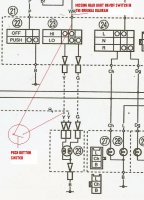
Please see sketch of head light passing switch. all you need are two lengths of wire and a push botton switch and connect as shown red lines.
Note:
The T135 wiring diagram has no on of switch for the head light. The wire connection should be made on the power side before it enters the switch.
good luck
Note:
The T135 wiring diagram has no on of switch for the head light. The wire connection should be made on the power side before it enters the switch.
good luck
Attachments
-
 54.4 KB Views: 794
yeah guys.. a passing light switch is for use when passing seemingly dangerous spots...
what it does it momentarily turns on the high beam...
e.g. going straight on a junction with opposite vehicles turning right...
so when you're approaching, if the vehicle seems like gonna move out... you press the passing light once or twice to warn him you're passing and not stopping for him to pass...
or when moving around corners that have a blind spot on the other side... flash lights to warn opposite...
-----------
Glowplug... thats exactly what i had in mind.. seems like thats the cleanest way to do it...
thanks for the pic really...
mugen_tenchi
New Member
I initially thought of the same project; namely a passing light switch. But simply wiring the high beam line to the power line is not wise. For example, during nighttime riding, we are expected to use our main headlamps (on low beam). The schematic above indicates that when I press the passing light switch, the high beam will also illuminate along with the low beam, shortening the life of the bulb. Here is my Passing Light Project:
---
For seven years, I have been driving our family's AUV. The advent of increasing gasoline price made it unreasonable for me to use our vehicle as my daily commuter to-and-from work. Circumstances thus made me decide to buy my very first motorcycle.
Being used to driving four-wheeled vehicles, I was baffled by my motorcycle's lack of ability to flash its headlamp's high beam as a warning signal for oncoming vehicles. I have gotten into the habit of using the high beam warning flash as a driving courtesy (in contrast to banging the horn unnecessarily, which oncoming traffic oftentimes ignores), and I find it quite bothersome to release the throttle just to toggle my headlamp switch on-and-off. Making hand signals works fine by day, but will often be ignored during nighttime riding. Thus, I came up with this project.
I want my flasher switch to work exactly the way as flasher switches on four-wheeled vehicles work. That is, (1) activating the switch when the headlamp is off will turn on the headlamp's high beam as long as the switch is held, and (2) activating the switch when the headlamp is on (low beam) will turn off the low beam and turn on the headlamp's high beam as long as the switch is held.
After consulting the electrical section of the T135 Service Manual, I finally came up with a simple circuit to address the objectives of my project.

I initially came up with a simpler schematic than the one showed above; however, my initial design requires a Double Pole Double Throw (DPDT) miniature push-button switch. My failure to procure the required switch prompted my to add a DC relay (to act as another pole in conjunction with the SPST push-button switch) and a rectifier (headlamp runs on AC; I failed to find a low-voltage AC relay). The picture below shows how I tested the relay-rectifier combo.

Now that my switching components have been tested to work, I used a double-sided tape to stick the two components together, as an effort to reduce space consumption.


In my excitement, I forgot to bridge the two yellow wires together (headlamp high beam line); the most important aspect of my project!

After splicing the aforementioned wires together, here it is, my finished project:

I chose to place the push-button switch there so that when worse comes to worst, I could simultaneously flash my lamp and sound my horn to warn off any oncoming traffic.
---
For seven years, I have been driving our family's AUV. The advent of increasing gasoline price made it unreasonable for me to use our vehicle as my daily commuter to-and-from work. Circumstances thus made me decide to buy my very first motorcycle.
Being used to driving four-wheeled vehicles, I was baffled by my motorcycle's lack of ability to flash its headlamp's high beam as a warning signal for oncoming vehicles. I have gotten into the habit of using the high beam warning flash as a driving courtesy (in contrast to banging the horn unnecessarily, which oncoming traffic oftentimes ignores), and I find it quite bothersome to release the throttle just to toggle my headlamp switch on-and-off. Making hand signals works fine by day, but will often be ignored during nighttime riding. Thus, I came up with this project.
I want my flasher switch to work exactly the way as flasher switches on four-wheeled vehicles work. That is, (1) activating the switch when the headlamp is off will turn on the headlamp's high beam as long as the switch is held, and (2) activating the switch when the headlamp is on (low beam) will turn off the low beam and turn on the headlamp's high beam as long as the switch is held.
After consulting the electrical section of the T135 Service Manual, I finally came up with a simple circuit to address the objectives of my project.
I initially came up with a simpler schematic than the one showed above; however, my initial design requires a Double Pole Double Throw (DPDT) miniature push-button switch. My failure to procure the required switch prompted my to add a DC relay (to act as another pole in conjunction with the SPST push-button switch) and a rectifier (headlamp runs on AC; I failed to find a low-voltage AC relay). The picture below shows how I tested the relay-rectifier combo.
Now that my switching components have been tested to work, I used a double-sided tape to stick the two components together, as an effort to reduce space consumption.
In my excitement, I forgot to bridge the two yellow wires together (headlamp high beam line); the most important aspect of my project!
After splicing the aforementioned wires together, here it is, my finished project:
I chose to place the push-button switch there so that when worse comes to worst, I could simultaneously flash my lamp and sound my horn to warn off any oncoming traffic.
